

An AI assistant can produce fluent English and still struggle with the people a Nigerian business serves. The harder test begins when a customer changes language, uses an unfamiliar spelling or sends a voice note with background noise.
For a team building that assistant, the data question is specific: which examples would show whether it understands the customer and completes the task correctly? A large collection of translated sentences may help, but it cannot answer every question about real use.
Rust7’s view is that local-language data should be treated as a product requirement from the beginning. That means defining the audience, preserving how people communicate and evaluating the decisions the system will make.
What the research tells us
There is a growing foundation to build on. The 2025 NaijaVoices paper describes 1,800 hours of speech paired with text, from more than 5,000 speakers, across Hausa, Igbo and Yoruba. Its speech-recognition experiments show that targeted data can improve the models tested. These figures describe that research release; they do not establish coverage of every Nigerian language or business setting. [1]
Evaluation work also shows why an English score is insufficient. IrokoBench introduced human-translated tests in 17 African languages across inference, mathematical reasoning and knowledge questions. The researchers found substantial performance gaps between high-resource and low-resource languages among the models they evaluated. That is evidence from a defined benchmark, rather than a verdict on every model available today. [2]
The practical implication is to measure the actual product in its intended language conditions. A model’s ability to answer a translated examination question does not by itself show whether it can interpret a customer’s delivery complaint.
Preserve how people actually communicate
“Supports Yoruba” or “supports Nigerian Pidgin” is a starting description. A sourcing brief needs more detail: written or spoken input, formal or conversational language, relevant varieties, mixed-language passages and the setting where communication happens.
Spelling variation deserves particular care. A 2024 study of Nigerian Pidgin found that adding real texts and generated spelling variants improved translation and sentiment-analysis results in its experiments. The lesson is not that every spelling must be standardised. It is that variation should be represented and tested deliberately. [3]
For text, keep the original message and record translations or normalised versions separately. For speech, define transcription rules for language changes, hesitation, unclear words and overlapping speakers. Have qualified speakers review those rules. A transcript that quietly replaces uncertain speech with a confident guess creates a misleading training example.
For a voice product, the collection plan should also reflect the intended recording conditions. Read speech in a quiet room can serve a different purpose from spontaneous conversation over a noisy phone connection. Neither should be presented as a substitute for the other without evidence.
Buy data for a task, not just a language
Different products need different annotations. A transcription system needs audio aligned with accurate text. A support classifier needs messages with agreed categories. A conversational assistant needs examples of useful responses, limits and appropriate escalation.
AfriSenti illustrates how a dataset can be built around a precise task. Its 2023 paper presents more than 110,000 tweets in 14 African languages, including Hausa, Igbo, Nigerian Pidgin and Yoruba, annotated for sentiment by native speakers. It is a valuable research resource for that task; its existence does not make it a ready-made customer-support dataset. [4]
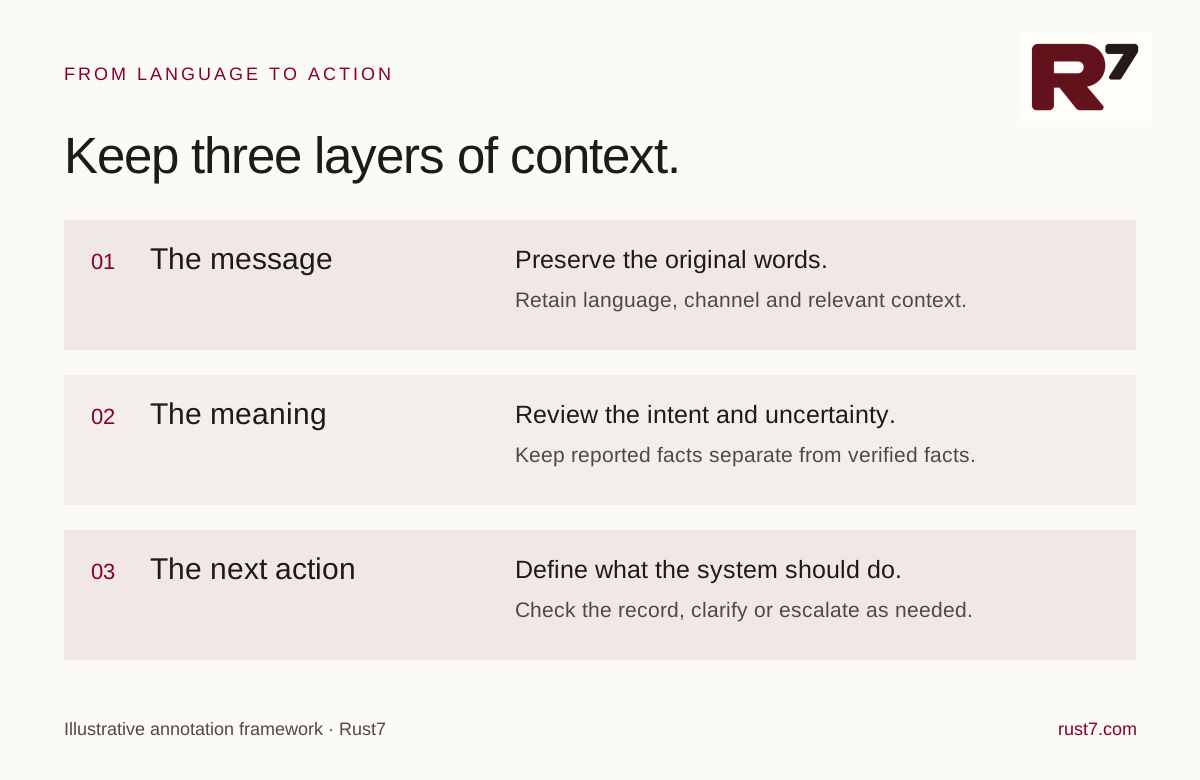
Consider a fictional delivery assistant receiving: I don pay, but my order never reach.
An illustrative reading is that the customer says they have paid and have not received the order. A useful system should identify the complaint and follow the agreed verification process. It should not treat the statement as proof that payment has settled or promise a refund without checking the order.
The data specification therefore needs more than a translation. It should distinguish the customer’s reported facts, the intended request, the information needed next and the actions the assistant is allowed to take. A language reviewer should validate the wording and interpretation before an example enters a production dataset.
Make the evaluation resemble the job
Start with a small evaluation set reviewed by people who understand both the language and the task. Define success before selecting a model or buying a larger training collection. Keep the evaluation examples separate from material used to train or tune the system.
For a speech system, measure transcription errors and inspect whether important details—such as an amount, location or order reference—survive. For a support assistant, measure intent recognition, appropriate next steps and unsupported claims. Report results for the language and recording conditions you actually tested, with sample counts, rather than hiding uneven performance inside one average.
AfroBench reinforces the value of looking across tasks. The 2025 benchmark spans 64 African languages, 15 tasks and 22 datasets, and reports performance gaps across much of its evaluation. Broad benchmarks help identify weaknesses; a company still needs an evaluation tied to its own customers and workflow. [5]
Ask reviewers to record disagreements and their resolution. If fluent speakers interpret a message differently, that uncertainty is useful information. It may call for more context, a revised label or a system response that asks the customer to clarify.
Check access and permitted use separately
A dataset can be easy to discover without being available for every commercial use. At the time of review, the NaijaVoices dataset card lists a CC BY-NC-SA 4.0 licence and directs commercial users to separate arrangements. The visible download page is therefore not enough to establish that a planned commercial project is covered. [6]
Rust7 recommends recording the exact dataset version, applicable terms, source permissions and intended use before procurement. For a commissioned collection, define what contributors are told, how recordings will be used, who can access them and how sensitive content will be handled. These are project requirements to resolve, rather than details to leave until after collection.
What a useful buyer brief contains
- Audience and setting.Name the languages and varieties in scope, the communication channel and the business situation. State exclusions explicitly.
- Unit of delivery.Specify whether each item is an audio segment, transcript, message, conversation or reviewed response. Include the context needed to interpret it.
- Annotation and review.Define labels, transcription conventions, reviewer qualifications and how uncertain cases are resolved.
- Coverage and acceptance.Request a documented sample, coverage counts and evaluation criteria for the intended task. Set thresholds with evidence from the pilot.
- Rights and maintenance.Establish permitted uses, versioning, delivery documentation and how corrections or future updates will be handled.
The opportunity is to make Nigerian language data useful in the situations where people need AI to work. That takes careful sourcing, language expertise and a clear definition of success—not simply a larger file.
Planning a project? Explore data sourcing with Rust7. If you maintain a dataset or bring language expertise, see our data partnership and contributor pages.
Sources & research notes
Primary sources checked on 25 October 2026. Recommendations and illustrations are Rust7’s editorial guidance, not reports of client work. The delivery-assistant example is fictional.
- Emezue et al. · The NaijaVoices Dataset (Interspeech 2025)
The 2025 paper describes a specific speech-data release and model experiments. The article does not treat its figures as current inventory or comprehensive language coverage.
- Adelani et al. · IrokoBench (NAACL 2025)
Human-translated evaluation across 17 African languages and three task families. Reported findings concern the models and settings evaluated in the paper.
- Lin et al. · Modeling Orthographic Variation Improves NLP Performance for Nigerian Pidgin (LREC-COLING 2024)
Evidence from translation and sentiment experiments; not a universal claim about normalisation or every downstream task.
- Muhammad et al. · AfriSenti (EMNLP 2023)
A native-speaker-annotated sentiment benchmark from tweets. Dataset size and languages refer to the published research.
- Ojo et al. · AfroBench (ACL Findings 2025)
A multi-task benchmark covering 64 African languages, 15 tasks and 22 datasets. Results are not a current ranking of all available models.
- NaijaVoices · Dataset card and licence
Card checked on 25 October 2026: CC BY-NC-SA 4.0 listed, with separate arrangements for commercial use. Confirm the exact release and applicable terms for any acquisition.
Rust7 · Enterprise data and human expertise for frontier AI.
Read: From dirty data to dependable datasets in Nigeria →